VR soft skills training. How virtual reality develops leaders and teams
See how VR training helps develop communication, leadership, sales and teamwork through realistic simulations and safe practice.
By Aleksander Caban · Co-founder, Carbon Studio
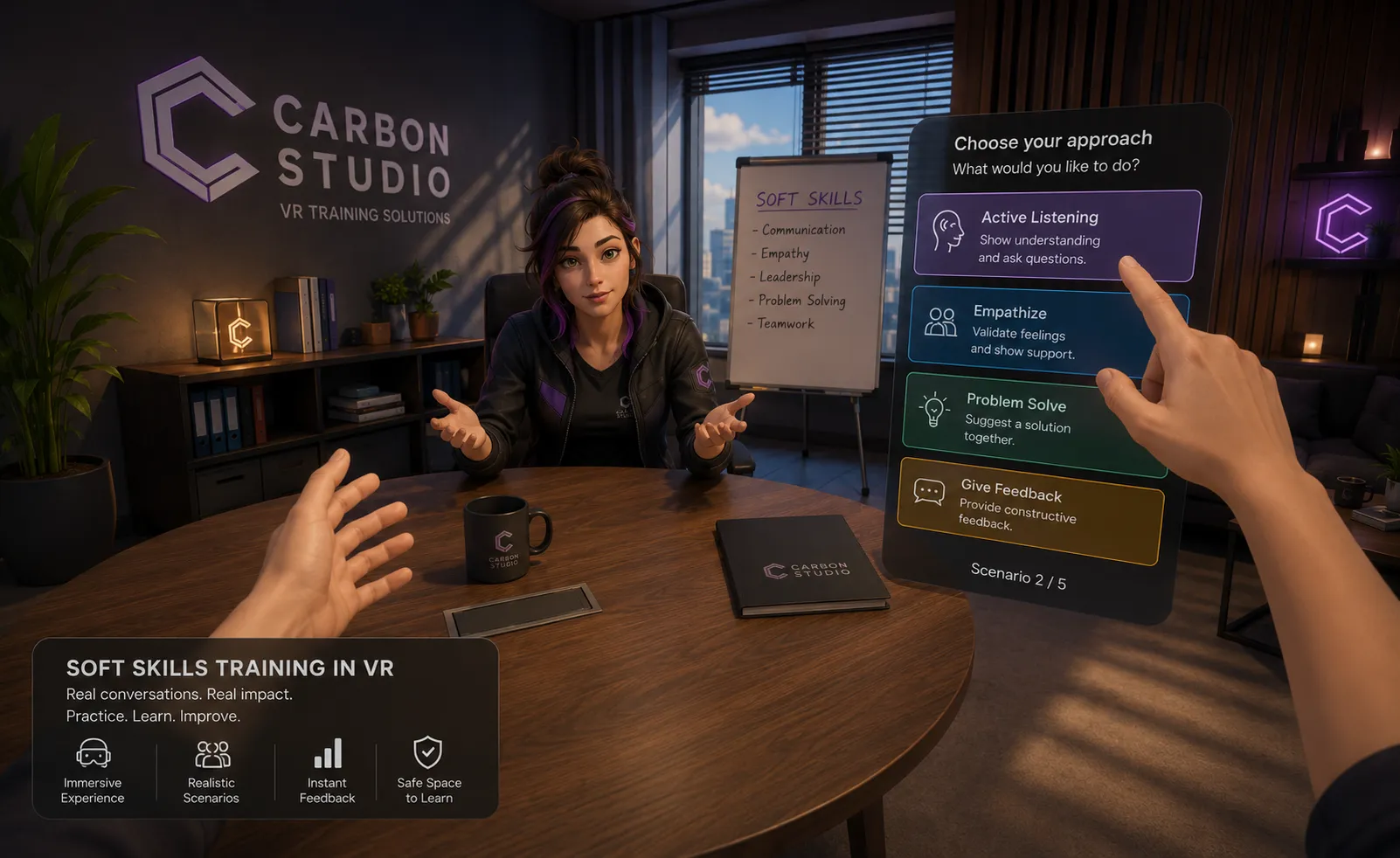
VR soft skills training uses interactive simulations of real workplace situations, in which participants practise communication, leadership, sales and teamwork under realistic — but completely safe — conditions. Instead of listening to theory, they hold a difficult conversation with a virtual character, watch how it reacts, make mistakes and repeat the exercise — with no consequences for customers, colleagues or the organisation.
Soft skills are best developed through practice. It is hard to learn how to handle a conversation with an unhappy employee, deliver constructive feedback or respond to conflict from a presentation, a video or a knowledge test alone.
Training built on virtual reality moves the participant into a realistic professional situation and safely tests how they behave under pressure. They can make decisions, hold conversations, observe how virtual characters react, make mistakes and repeat the exercise many times — with no consequences for customers, colleagues or the organisation.
This is why VR is increasingly used not only in technical and health-and-safety training, but also in developing leadership, communication, sales, customer service and teamwork.
What is VR soft skills training?
VR soft skills training is an interactive simulation of a workplace situation in which the participant is not merely an observer. They become an active part of the scenario.
After putting on a VR headset they may find themselves, among others:
- in an office during a difficult conversation with an employee,
- in a project meeting where conflict is escalating,
- facing a customer making a complaint,
- in a sales conversation or a negotiation,
- in front of a large audience,
- in a job interview,
- in a crisis requiring a fast decision,
- in a workplace where they must respond to inappropriate behaviour.
Modern simulations can use branching scenarios, speech recognition, AI-driven virtual characters, recording of what the participant says and analysis of their decisions. Solutions available on the market now combine realistic conversations with virtual humans, automatic feedback, perspective switching, group sessions and results analysis.
Why does VR work for developing soft skills?
Practice instead of passive watching
In traditional training the participant usually listens to a trainer, reviews examples or role-plays with another person. In VR they have to respond to the situation themselves.
A virtual employee may question their manager’s decision. A customer may end the conversation or react emotionally. A team member may not accept feedback the way you expect. The participant does not simply pick an answer in a test — they experience the consequences of how they communicate.
A safe environment for making mistakes
We often avoid difficult conversations because we fear the other person’s reaction. In VR you can test different approaches without risking a damaged relationship, a lost customer or an escalated conflict.
The participant can stop the exercise, start again and see how a change of tone, argument or sequence changes the outcome. These conditions help build confidence before applying new skills in a real professional situation.
Greater engagement and focus
Inside a headset the participant is cut off from most distractions: the phone, messages, email and conversations happening around them. Their attention stays on the training situation.
In a PwC study on inclusive leadership training, participants using VR completed the material four times faster than the classroom group. They were also more focused and reported a stronger emotional connection to the content. PwC notes that the cost benefits are greatest at sufficient deployment scale.
This does not mean every VR training will automatically be four times more effective. The result depends on the quality of the scenario, the training method used, the group of participants and how effects are measured. The study does show, however, that well-designed immersion can significantly increase the intensity of the learning experience.
Real emotions under controlled conditions
Communication, leadership and negotiation are strongly tied to emotion. Knowing the technique is not enough when an employee has to apply it under pressure.
A well-designed VR scene can trigger stress, uncertainty, empathy or a sense of responsibility close to what appears in a real meeting. The participant therefore learns not only what to say, but how to react when the situation does not go to plan.
Research from the Stanford Accelerator for Learning indicates that immersive environments can support the development of empathetic communication in managers. In the scenario studied, participants held a performance review conversation with a virtual employee and then analysed their own behaviour.
Seeing it from the other person’s perspective
One of the unique capabilities of VR is switching perspective. A participant can first play the manager, then see the same situation through the employee’s eyes.
This can be used in training on empathy, inclusion, and preventing discrimination, harassment and unconscious bias. It can also help leaders understand how their words, tone of voice and behaviour are received by others.
Which soft skills can be developed in VR?
Leadership and team management
Simulations can prepare current and future managers to delegate tasks, motivate employees, hold development conversations, give constructive feedback, respond to falling engagement, communicate change, run performance reviews, manage conflict and make decisions under pressure.
The scenario can change depending on the participant’s behaviour. Communication that is too aggressive may lead to escalation, while avoiding specifics may leave the problem unresolved.
Communication and difficult conversations
VR can be used to practise active listening, formulating clear messages, asking questions and responding to the other person’s emotions.
Example situations include a conversation with an employee after a failed project, delivering an unpopular decision, refusing a raise, responding to behaviour that breaches company rules, or talking to someone under strong emotion.
Sales, negotiation and customer service
Virtual customers can represent different personality types, levels of knowledge and attitudes to the product. An employee can practise diagnosing needs, presenting the value of an offer, handling objections, negotiating terms, responding to a complaint, de-escalating tension and serving a demanding customer.
After the exercise, the system can analyse the decisions made, the arguments used, the order of statements and reaction times.
Public speaking and presentations
VR lets people present to a virtual audience that can react to the presentation, talk among themselves, lose interest or ask questions. Analysis can cover speaking pace, length of statements, pauses, filler words, eye contact and use of space.
Collaboration and team communication
A multi-user simulation can give a team a task that cannot be completed without exchanging information, dividing responsibility and making decisions together.
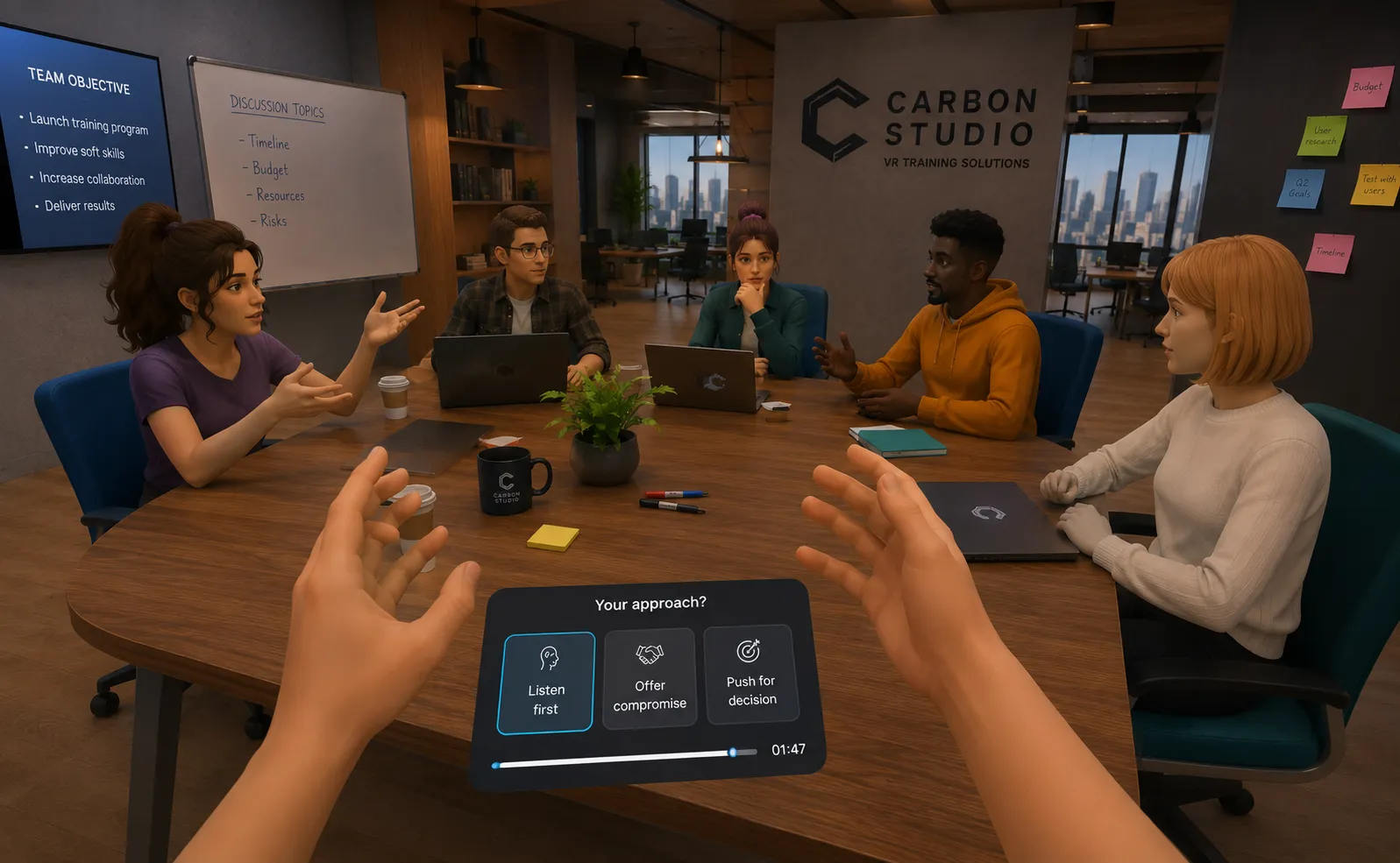
This model lets you observe not just the final result but how the team works: who takes the initiative, whether information reaches everyone, how the team reacts to mistakes, whether the leader listens to the others, how decisions get made and what happens under time pressure.
Shared VR environments are used both to run group training and to support collaboration between teams in different locations.
Empathy, inclusion and preventing inappropriate behaviour
Rather than merely describing the consequences of discrimination or exclusion, VR can place the participant in the middle of such a situation.
They can experience the scene from the perspective of someone whose voice is ignored, who meets prejudice, or who witnesses inappropriate behaviour towards a colleague. They can then practise the right response.
This kind of training should not stop at triggering emotion. It should lead to a specific behaviour the participant is able to apply at work.
What does custom VR training look like?
A well-designed project should start not with choosing technology, but with defining a real organisational problem.
1. Needs analysis
At the start you define: the behaviours that need to change, the target group, the situations employees find hardest, the industry context and organisational culture, and how the result will be assessed.
2. Scenario design
The scenario is created together with the client, subject-matter experts, trainers and experience designers. It can include several paths, different reactions from the other party, consequences of decisions and a gradually rising level of difficulty.
3. Producing the environment and characters
Depending on the goal, you can reproduce a real office, shop, medical ward, factory floor or conference room — or create an entirely new environment.
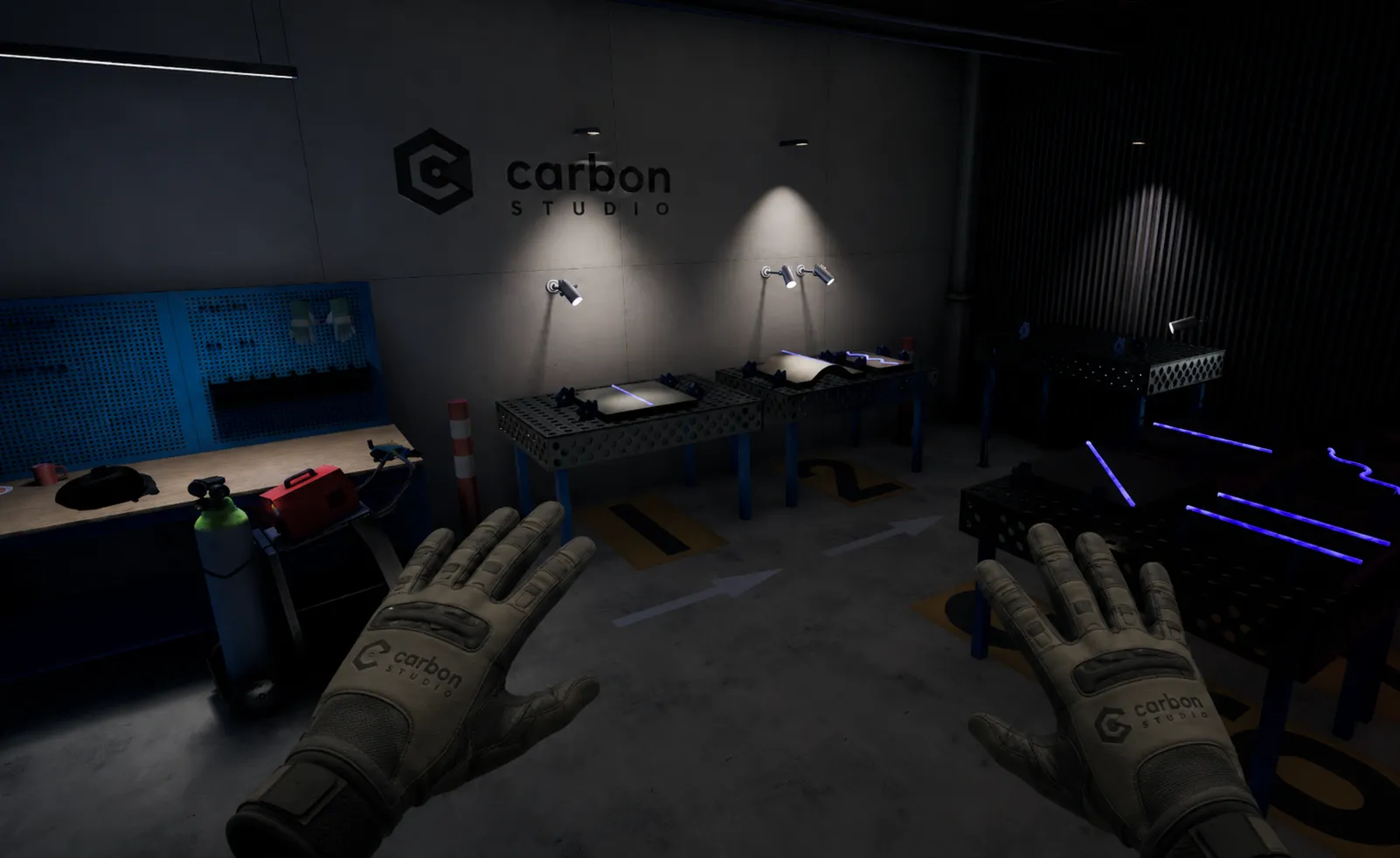
Realistic presentation is not only a visual element. It helps the participant recognise the situation and carry the behaviours they have practised back into the real workplace.
4. Interaction and feedback
The training can use multiple-choice responses, free conversation with a virtual character, speech recognition, gestures and full-body movement, a branching scenario, playback of a recording, automatic feedback, a debrief with a trainer and comparison of results across attempts.
5. Pilot and scaling
Before rolling training out across the organisation it is worth running a pilot with a selected group. It lets you check the usability of the application, the difficulty level, participant reactions and how effects are measured.
Once validated, the solution can be rolled out to further sites, languages and scenario variants.
How to measure the results of VR training
One significant advantage of digital simulations is the ability to collect consistent data. Depending on the project you can measure:
- scenario completion,
- decisions made,
- reaction time,
- number of repetitions,
- change in results between attempts,
- the order of actions taken,
- knowledge before and after training,
- the participant’s self-assessment and confidence,
- completion of specific behaviours required by the organisation.
Reports can present results for an individual, a team, a site or the whole organisation. Market solutions already offer individual and group analytics, LMS integration and automatic reporting of employee readiness.
Bear in mind, however, that the number of clicks or time spent in the application is not yet evidence of a change in competence. Metrics should be tied to specific behaviours and business goals.
Off-the-shelf platform or a custom VR application?
Off-the-shelf platforms can work well when an organisation needs to launch standard training quickly — for example on public speaking, communication basics or holding management conversations.
A custom VR application is the better choice when:
- the scenario should reflect your company’s specific procedures,
- industry realities and specialist vocabulary matter,
- a real workplace needs to be reproduced,
- the training must be available in several languages,
- the organisation needs its own reporting system,
- integrations with existing systems are required,
- the solution is meant to be developed over the coming years,
- the client wants to retain control over the application and its intellectual property.
The market offers libraries of ready-made modules, no-code platforms, interactive 360° films, and fully custom simulations built for a specific organisation.
Why build VR training with Carbon Studio?
Carbon Studio has specialised in virtual and mixed reality experiences since 2015. We deliver custom applications, simulations and XR projects, supporting the work from concept and design through development, testing and ongoing maintenance.
Our team combines developers, designers, UX specialists and 3D artists. We work in Unreal Engine and Unity, building projects for all the major VR platforms. Carbon Studio has worked with Meta, Pico and Games Workshop, among others.
The experience gained building full VR games matters particularly in training projects. An effective simulation has to be not only technically correct, but also intuitive, engaging and believable. The participant must understand what they can do, get a clear response from the system and feel that their decisions matter.
Depending on your needs, a project can include custom 3D environments and characters, realistic conversation scenarios, branching decision paths, voice interaction, AI-driven characters, single-user or multi-user modes, a results dashboard and reporting, LMS integration, desktop versions complementing the VR experience, and builds for Meta Quest, Pico, HTC Vive or PC VR.
When is VR training the right choice?
VR training is worth considering when employees need not only to learn the rules, but above all to apply them in a situation that demands action.
It can bring the greatest value where situations are hard to role-play regularly, mistakes in the real world are costly, the organisation needs to standardise training, participants work across many locations, repeated practice matters, measurable results are needed, or traditional e-learning does not generate enough engagement.
VR does not have to replace trainers, workshops or coaching entirely. The best results often come from a hybrid model: theoretical preparation, practice in a VR simulation, feedback, and a debrief with a facilitator.
Want to see what VR training could look like in your company?
Carbon Studio builds custom training applications and VR/XR simulations — from needs analysis and scenario design through production, deployment and further development.
Get in touch: contact@carbonstudio.pl
Key takeaways
- VR soft skills training turns theory into experience — participants practise communication, leadership, sales and teamwork in realistic situations, without the risk that comes with the real workplace.
- The headset is not the point. The value is the ability to rehearse a specific behaviour repeatedly, see its consequences and get feedback.
- In a PwC study, VR learners completed the material four times faster than the classroom group — but the result depends on the quality of the scenario, not on the technology itself.
- Perspective switching is unique to VR: a participant can see the same situation through the manager's eyes and through the employee's. That is the foundation of empathy and inclusion training.
- A custom application beats an off-the-shelf platform where company procedures, industry realities, your own reporting and IP control matter.
- Measure behaviours, not clicks — clicks and time in the app are not evidence of changed competence. Metrics have to be tied to business goals.
Frequently asked questions
+ Is VR suitable for soft skills training?
Yes. VR is particularly well suited to developing skills that require practice, such as communication, leadership, feedback, sales, negotiation, customer service and conflict resolution.
+ What does a soft skills training session in VR look like?
The participant puts on a headset and is placed in a realistic workplace situation. They talk to a virtual character, make decisions or collaborate with other people. After the exercise they receive feedback and can repeat the scenario.
+ Can VR training use artificial intelligence?
Yes. AI can drive the behaviour of virtual characters, analyse what is said, generate varied reactions and prepare personalised feedback. How far AI is used depends on project requirements, data security and how predictable the scenario needs to be.
+ Does every employee need their own headset?
No. One headset can be used by many participants at different times. At larger scale you can prepare device kits for individual sites, or complement the VR application with a desktop version.
+ Can the application be adapted to a specific company's procedures?
Yes. A custom simulation can reproduce your organisational culture, procedures, products, workplaces, typical customers and the real problems that occur in your company.
+ Can participant progress be measured?
Yes. The system can record decisions, reaction times, the number of attempts, completed stages and score changes. The data should be tied to training and business goals agreed in advance.
+ How long does it take to build VR training?
Production time depends on the number of scenarios, the level of realism, the interaction model, the number of languages and the integrations required. A simple pilot can cover one key scenario, which is then tested and developed further.
+ Can the training work without an internet connection?
Yes. Depending on the project, the application can run locally on the headset or on a computer. A connection may only be needed to sync results, manage users or use AI services.
Aleksander Caban
Co-founder, Carbon Studio
Co-founder of Carbon Studio, a Polish VR game studio behind The Wizards, Hunt Together, and Warhammer Age of Sigmar: Tempestfall. Writes about XR, AI, and the craft of immersive software.