Meta VR Glasses vs Steam Frame: which XR headset should you choose in 2026/2027?
Meta VR Glasses vs Steam Frame after the September 2026 launches: prices, specs, foveated streaming, Unreal Engine and how to pick an XR headset for business.
By Aleksander Caban · Co-founder, Carbon Studio
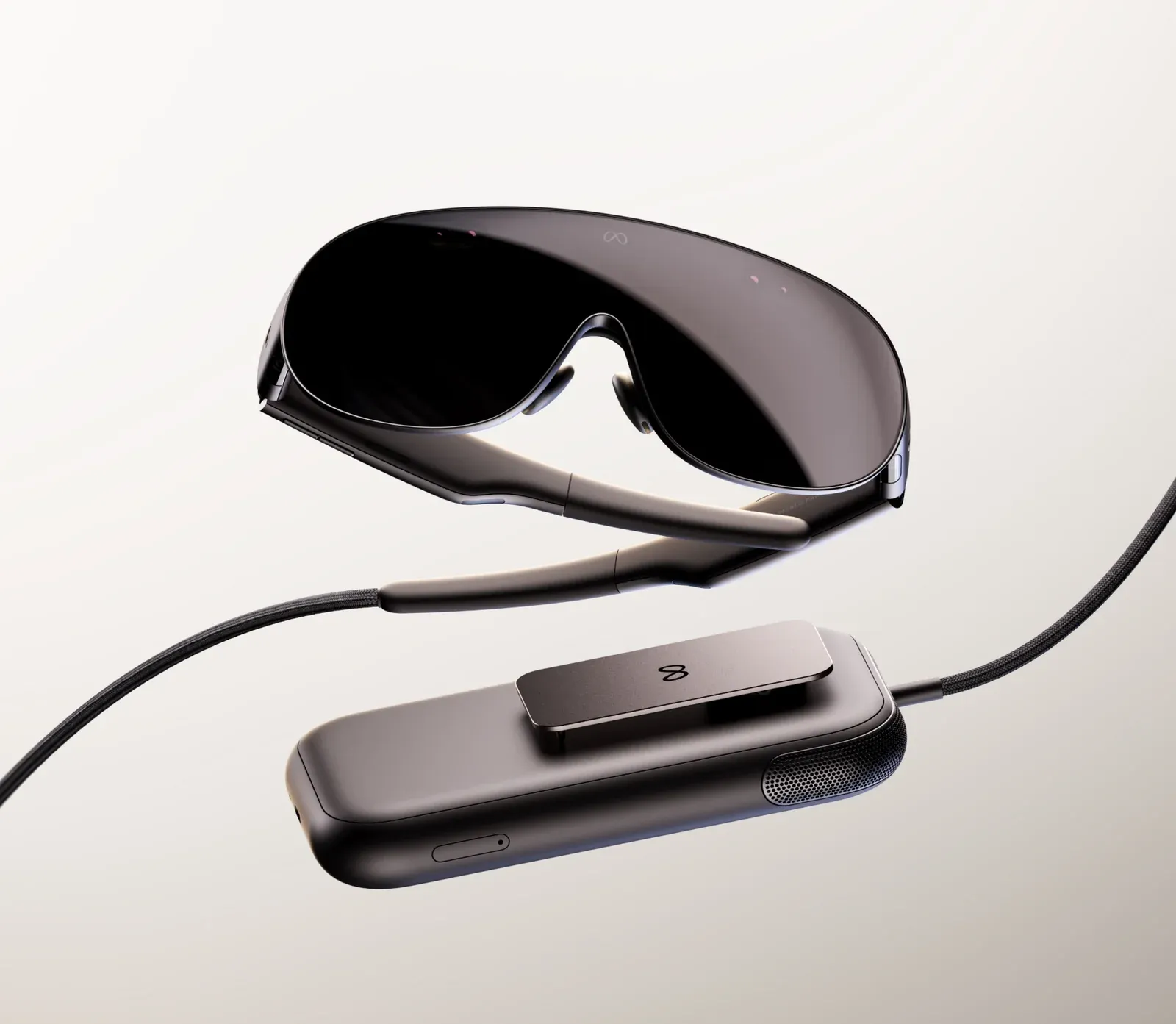
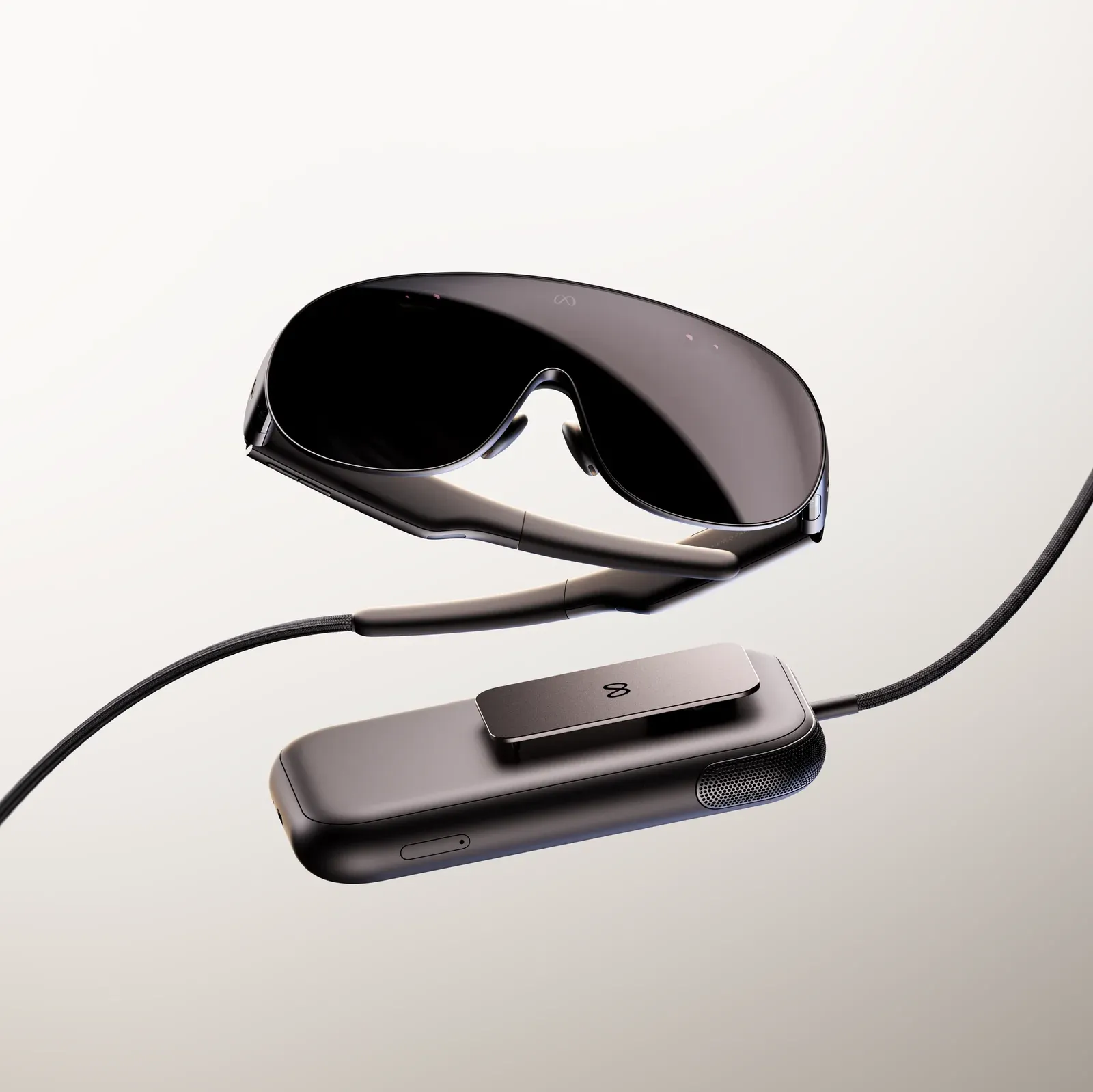
Meta VR Glasses are lightweight Meta VR/MR glasses with Horizon OS, 37 PPD micro-OLED displays and the main compute moved into a puck, meaning an external module. Steam Frame is Valve’s standalone headset with SteamOS 3, wireless PCVR, meaning VR streaming from a computer, and foveated streaming that improves image quality where you are looking. In short: Meta reduces weight on the face and controls the ecosystem, while Valve treats the headset as a Steam and PC terminal.

This article is written from the perspective of Carbon Studio S.A., a Polish VR/XR studio founded in 2015 and listed on NewConnect, creators of The Wizards series (500k+ copies) and Warhammer AoS: Tempestfall; beyond games, we build VR training, simulations and AI tools for enterprises. We have shipped projects on 16 different VR headsets, in both Unreal Engine and Unity, so we look at Meta VR Glasses and Steam Frame through the practical lens of ports, application maintenance and real deployments.
What should you know about Meta VR Glasses and Steam Frame in brief?
Meta VR Glasses were announced on 23 September 2026 at Meta Connect. The price is $1,299.99, the launch is planned for spring 2027, and Poland is on the launch-country list [1][2]. Meta Newsroom describes the device as hardware for 3D films, multi-screen work and games. In this article, I treat that as the manufacturer’s statement, not as a confirmed long-term test.
- Price: $1,299.99, or about $1,300 before local taxes and distribution.
- Date: announced on 23.09.2026, sales planned for spring 2027.
- Weight: about 100 g for the glasses and about 300 g for the compute, battery and storage puck.
- Display: dual micro-OLED 2412×2288 per eye, 37 PPD, up to 120 Hz, HDR and Dolby Vision.
- FOV: 70° horizontal and 66° vertical, about 87–88° diagonal.
- OS: Horizon OS, full Quest 3 library with Touch Plus controllers.
- Tracking: 6DoF, hand tracking, eye tracking, face tracking and iris authentication.
- In the box: glasses, puck, 45 W power supply and USB 3.2 Gen 2 cable; controllers are not included.
Steam Frame is Valve’s streaming-first standalone VR headset, meaning a standalone headset designed primarily for streaming games from a PC. The device was announced on 12 November 2025, sales started on 14 September 2026, and the first units shipped from around 18 September 2026 [8][9]. Valve lists prices and configurations on the official Steam Frame page [11].
- Price: 4,539 PLN for 256 GB and 5,549 PLN for 1 TB in Poland; the power supply costs 139 PLN.
- Date: announced on 12.11.2025, on sale from 14.09.2026, first shipments from around 18.09.2026.
- Weight: about 185–190 g core visor, meaning the front headset module, and about 435–440 g for the complete headset with a 21.6 Wh battery.
- Display: dual LCD 2160×2160 per eye, 72–144 Hz, with 144 Hz experimental.
- FOV: about 110°, clearly wider than Meta VR Glasses.
- OS: SteamOS 3 on Arch Linux ARM64, with Proton, FEX and Lepton.
- Streaming: Wi-Fi 6E USB dongle, dual radios, meaning two independent Wi-Fi modules, and eye-tracked foveated streaming.
- In the box: headset, controllers, Wi-Fi 6E adapter and Half-Life: Alyx; the power supply is not in the box.
How much do Meta VR Glasses cost, and what are their specs?
Meta VR Glasses move the battery, main chipset, cooling and part of the weight from the visor into an external puck module. The visor weighs about 100 g, has a magnesium-alloy frame, open periphery, passive cooling, two sizes and interchangeable nose pads [2][3]. Prescription lenses are planned through Zenni Optical.
The puck is an external module with the battery, storage and chipset, connected to the glasses by a thin, flexible fiber-optic cable. There is no compute in the glasses themselves, not even a tracking coprocessor. The puck weighs about 300 g and is roughly the size of two phones stacked on top of each other [1][4].
The puck uses Qualcomm Snapdragon Reality Elite, described as XR2 Gen 3 class. After its hands-on, Road to VR reported that the GPU is about 11% faster than the XR2 Gen 2 in Quest 3 [4][5]. It is paired with 12 GB of RAM, 128 GB of storage and microSD up to 1 TB.
The key trade-off is ergonomic. Meta does not remove energy and thermals; it moves them to a place the body tolerates better than the nose and cheeks. In VR, 100 g less on the face can change how a session feels more than a small increase in compute power.
How do Meta VR Glasses work: puck, 37 PPD optics, passthrough and tracking?
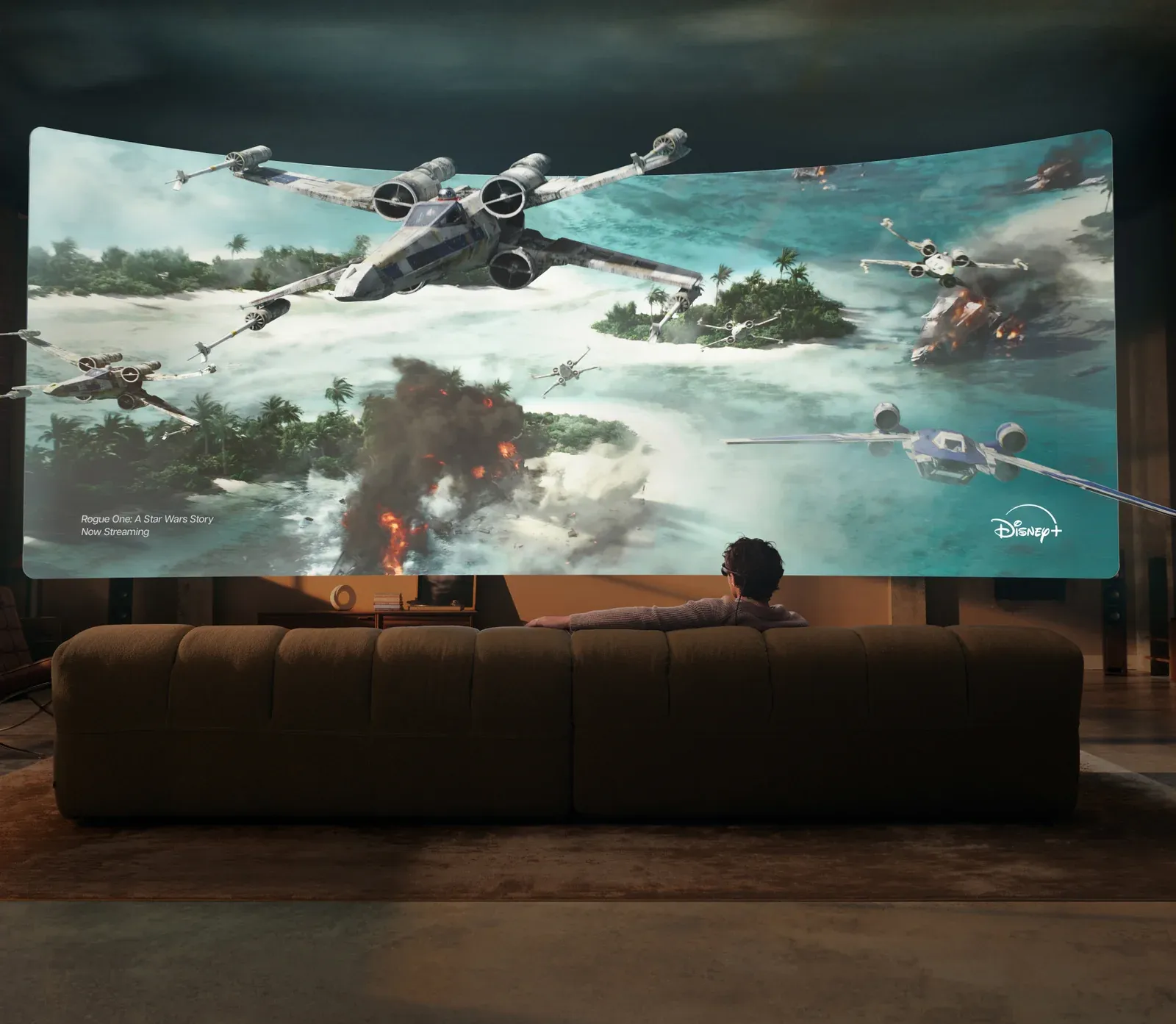
Meta VR Glasses prioritise image clarity, lightness and controller-free interaction, but pay for that with a narrower field of view. Meta calls the display system a 5K Infinite Display: two 2412×2288 micro-OLED panels per eye, about 5.5 MP per eye, up to 120 Hz, HDR, Dolby Vision and IMAX Enhanced certification [1][2].
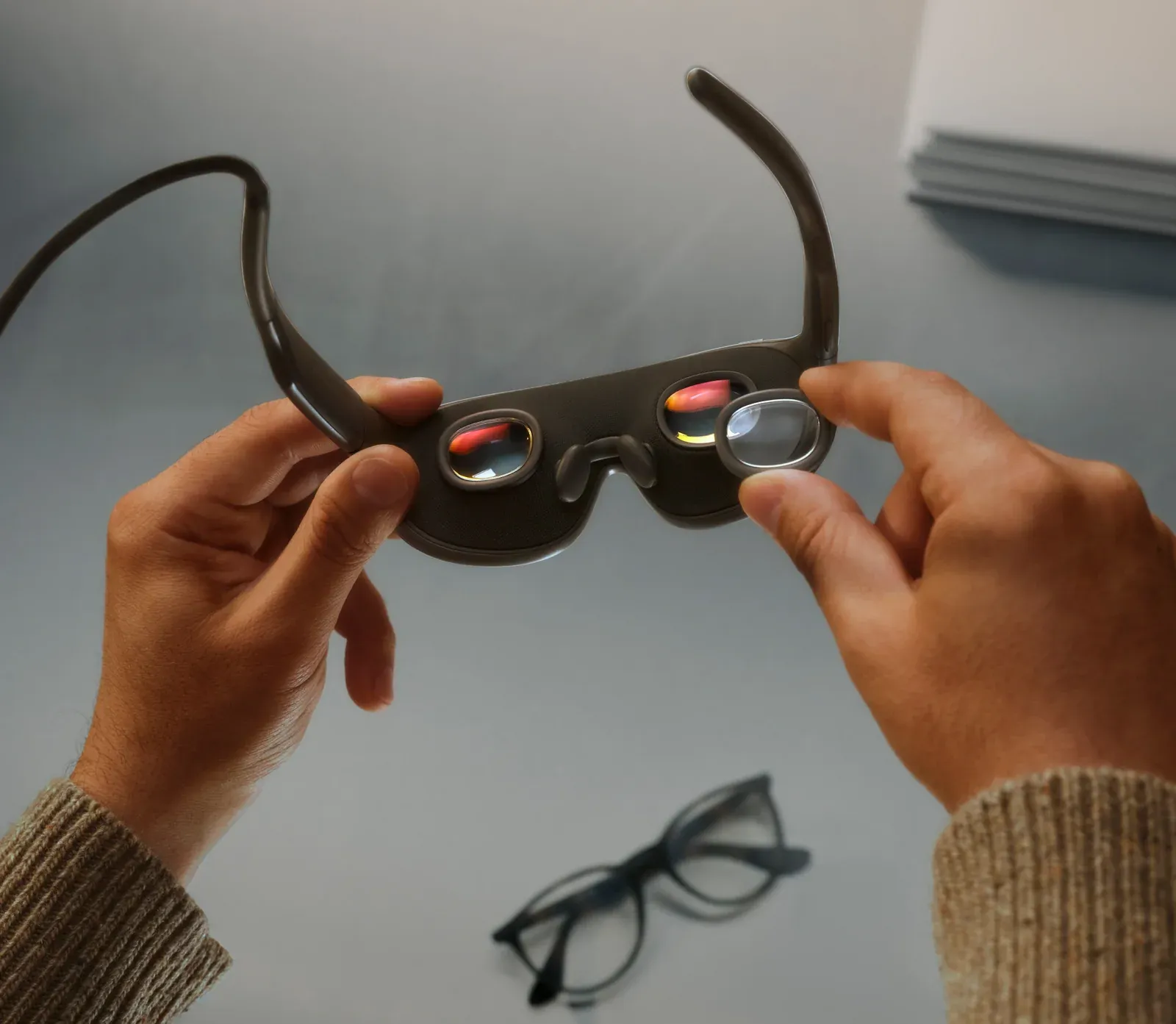
PPD means pixels per degree of field of view, a practical measure of perceived sharpness in a headset. Meta VR Glasses have 37 PPD, while Quest 3 has about 25 PPD and Apple Vision Pro 34 PPD [1][2]. For text, dashboards, films and B2B interfaces, that is a major difference.
The optics are pancake lenses with integrated eye tracking, meaning tracking of gaze direction. The FOV is 70° horizontal and 66° vertical, or about 87–88° diagonal [4][5]. Quest 3 is about 110°, so Meta is choosing a private screen and work over a maximum sense of presence.
Passthrough in Meta VR Glasses is full-colour, with 26 PPD, autofocus and depth sensing. Passthrough means seeing the surrounding world through the headset’s cameras. In Road to VR’s hands-on, the author called it the best he had seen in a standalone VR headset, citing no visible stitch lines and low latency [5]. That is a short-test impression, but it matters for MR.
Tracking includes 6DoF inside-out, hand tracking from four cameras, eye tracking from four cameras, face tracking and iris authentication [1][3]. Downward-facing cameras allow gestures while your hands rest in your lap. For longer sessions, that is not a detail; it is ergonomics.
Hand tracking is tracking the hands without controllers, used for gestures and spatial interaction. Meta describes gaze-highlight plus pinch, index-tap and thumb-swipe patterns as the basis of controller-free use [16]. Touch Plus controllers are compatible, but sold separately or as a bundle.
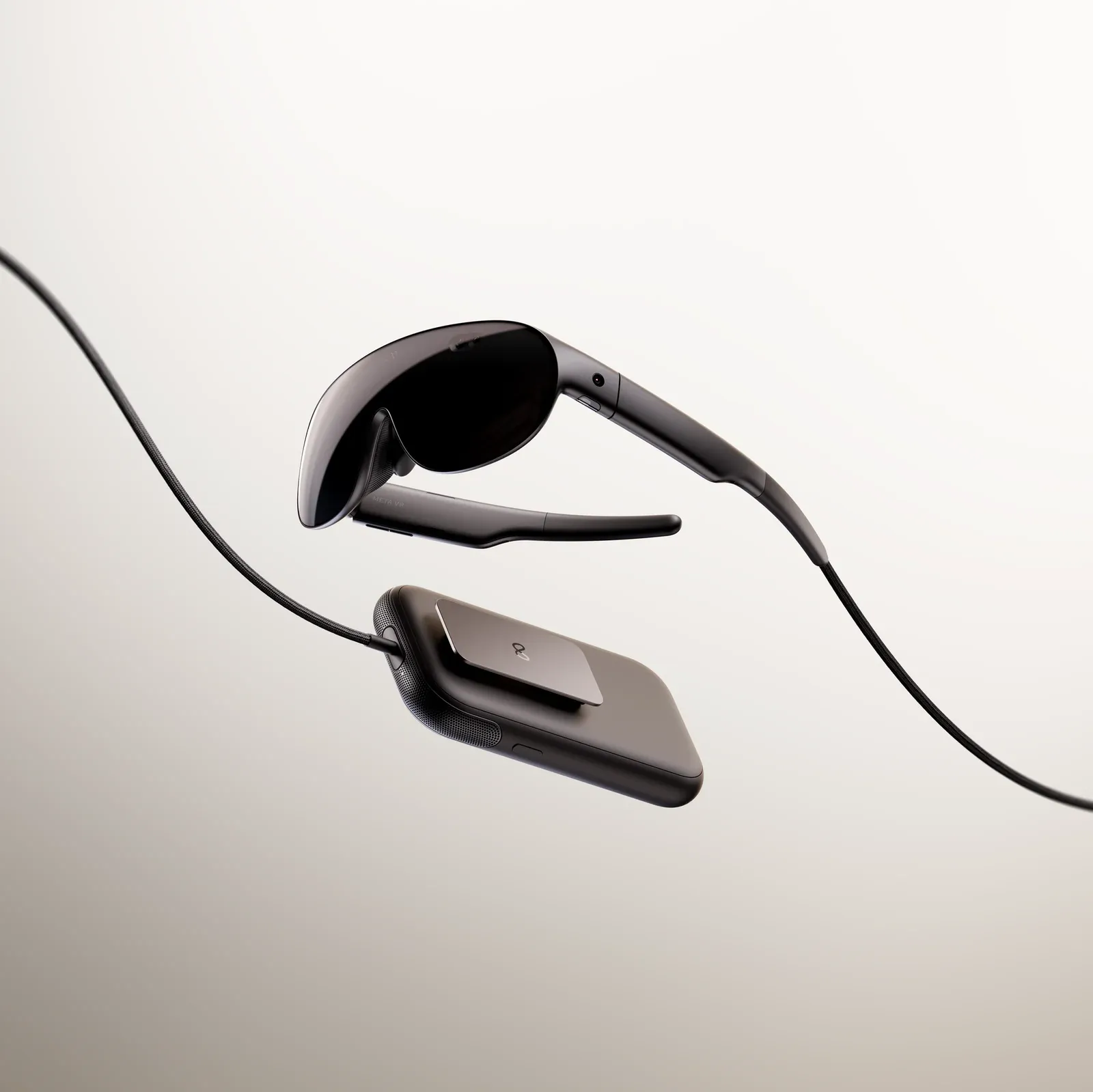
The battery in the puck is rated for about 3 hours of mixed use or media. Charging is via 45 W USB-C and can work while the device is in use [1][2]. Off-ear speakers are convenient, but hands-ons mention less bass and some audio bleed [5].
What do Meta VR Glasses mean for Quest developers?
Meta VR Glasses are a low-risk entry point for teams already building for Quest 3, but they require a shift in UX priorities. The device uses Horizon OS, the same SDKs and runs the full Quest 3 library; apps that need controllers work with Touch Plus [1][3].
From a developer perspective, Unity, Unreal, Interaction SDK, hand tracking and eye tracking remain. The application profile changes. Hand-based control stops being an experiment and becomes the primary interaction model, especially in business applications.
Meta is promising more than 75 hand-tracking-optimised titles at launch. These include a modified Beat Saber Flux mode with 35 songs, Tetris Effect: Mixed Realities, Phoenix Wright Ace Attorney: Dual Destinies VR, Two Point Hospital VR, Dragon Grove and Supernatural [6]. That signals Meta wants to teach the market to use VR without gamepads.
For UI, the quality threshold goes up. 37 PPD and 26 PPD passthrough make it possible to design text, instructions, work windows and data layers without excessive scaling. That matters in training, configurators and service applications.
Eye tracking enables foveated rendering, meaning rendering the highest quality where the user is looking, plus more subtle interactions. At Carbon Studio, we tested eye tracking in Reach The Clouds and described our findings in a piece on eye-tracked semi-physical VR climbing. The shortest lesson: gaze communicates intent well, but it should not replace every input.
How much does Steam Frame cost in Poland, and what is in the box?
Steam Frame is Valve’s headset for Steam users who want to bring their PCVR library and part of their Steam library into a standalone device. Sales started on 14 September 2026 after a randomised reservation system, and the first purchase emails and shipments began around 18 September [8]. Poland is covered like the other Steam Deck countries.

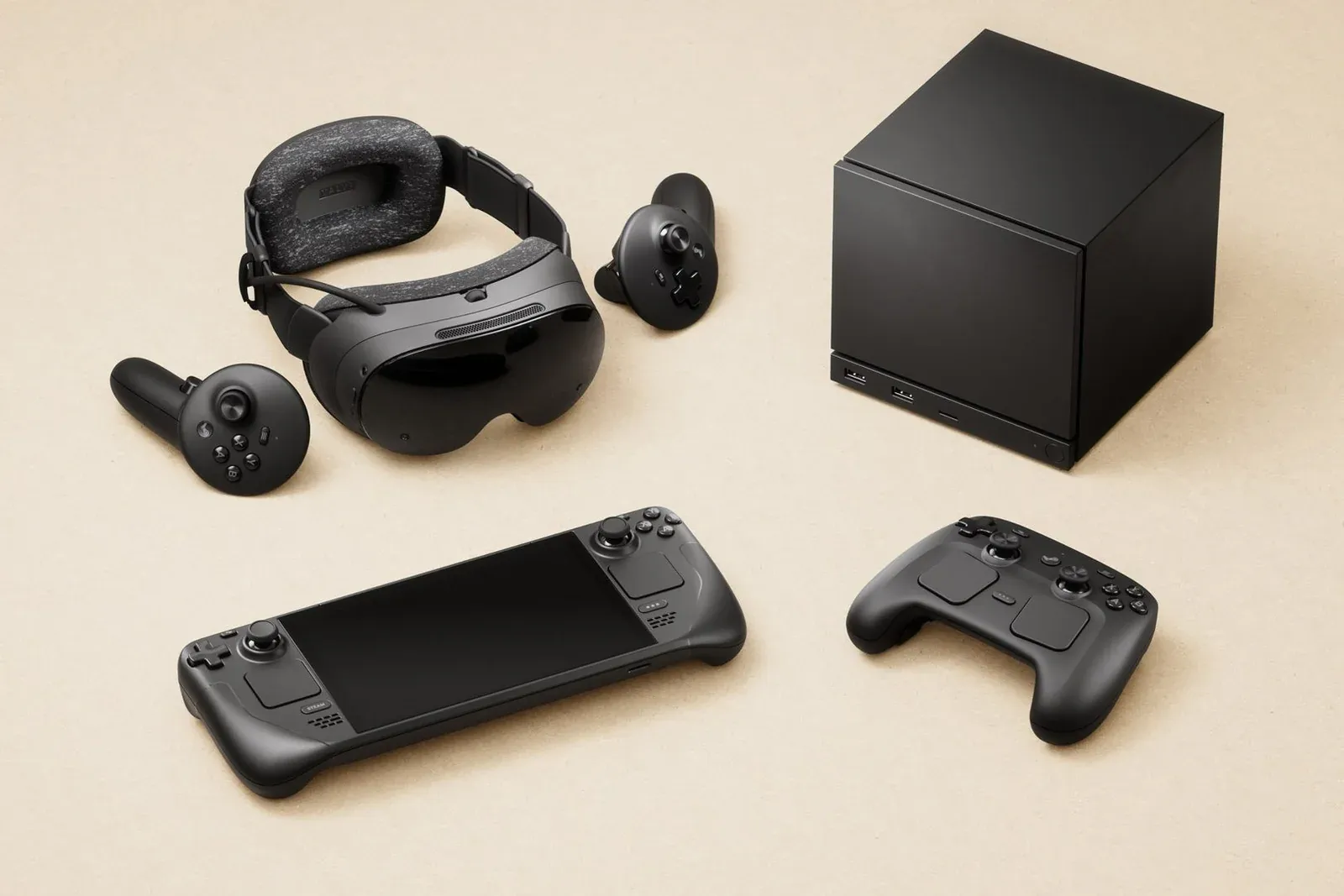
Polish pricing is one of the most important buying facts. Steam Frame 256 GB costs 4,539 PLN, while the 1 TB version costs 5,549 PLN [8][11]. Both kits include Steam Frame Controllers, a Wi-Fi 6E adapter and Half-Life: Alyx. The power supply is not in the box and costs 139 PLN.
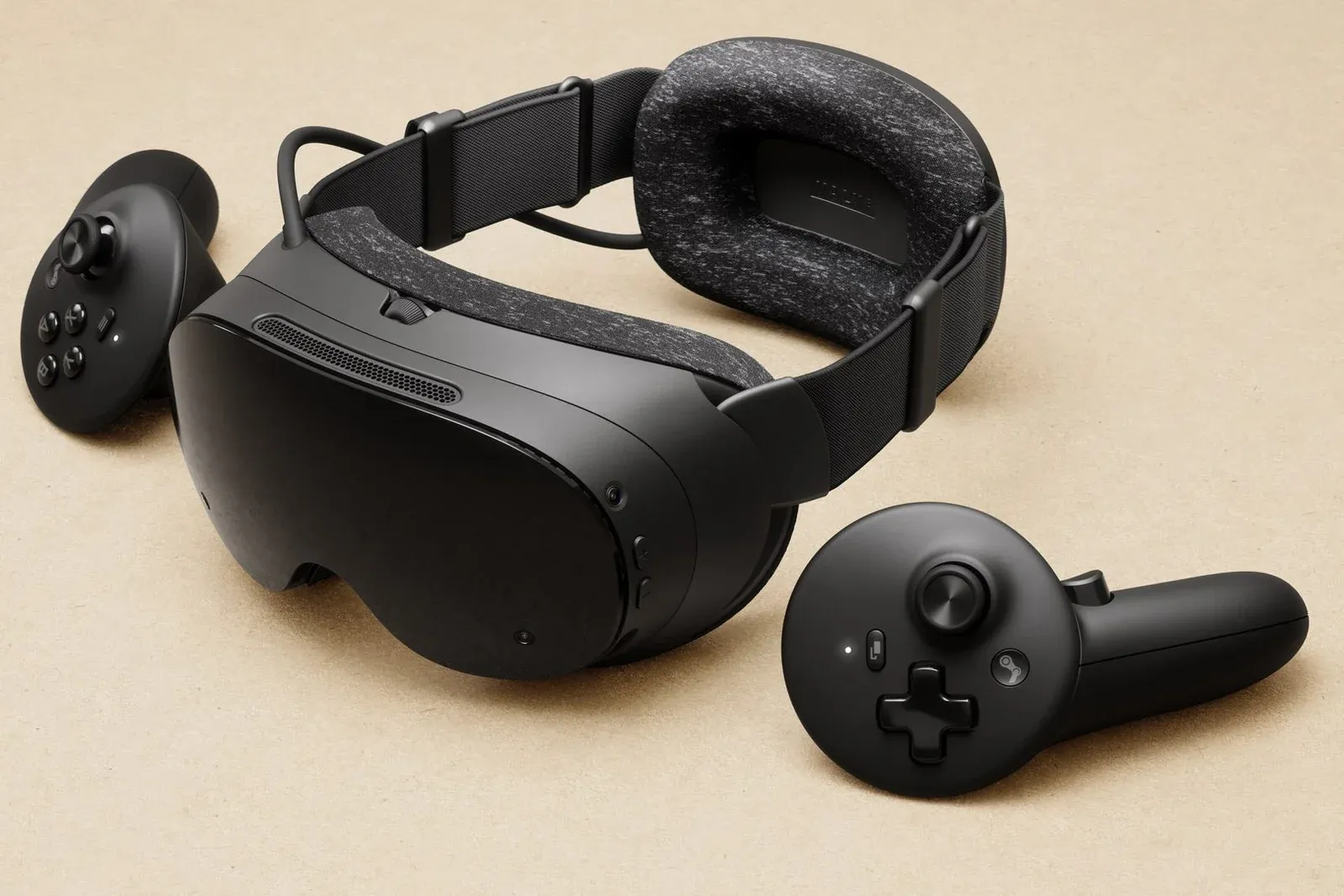
Steam Frame has two 2160×2160 LCDs per eye, 72–144 Hz refresh, pancake lenses, an approximately 110° FOV and a manual IPD dial [9][11]. The 144 Hz mode is experimental, while 120 Hz is standard. Compute is based on Snapdragon 8 Gen 3, 16 GB LPDDR5X unified memory, 256 GB or 1 TB UFS and microSD up to 2 TB.
Weight is distributed differently than in Meta VR Glasses. The core visor, meaning the front headset module, weighs about 185–190 g. The full kit with strap, facial interface, speakers and rear-mounted replaceable 21.6 Wh battery weighs about 435–440 g [9][13]. Valve has not published official battery life, and reviewers describe it as limited [14].
The Steam Frame Controllers (codename Roy) are ringless, have 18 IR LEDs each, full gamepad parity, TMR magnetic thumbsticks, capacitive sensing on every input and haptics. Each controller runs on one AA battery for about 40 hours [9].
How does foveated streaming work on Steam Frame?
Foveated streaming in Steam Frame pushes more video-stream bitrate to the place where the user is looking. This is not classic foveated rendering on the GPU, but an optimisation of the video transmission after rendering. Eye tracking controls where compression should be the gentlest [9][11].
Steam Frame uses the included Wi-Fi 6E adapter for this. The dongle creates a direct 6 GHz connection between the PC and headset, while a second radio can simultaneously handle internet over 5 GHz. Valve calls this dual radios, meaning two independent Wi-Fi modules [9][11]. For events and labs, that means less fighting with traffic on the regular network.
Reviewers praise the streaming quality. In the Linus Tech Tips review, Linus Sebastian said he never noticed image-quality degradation during foveated streaming, and HotHardware’s review roundup cites a measurement of about 5 ms of latency at 200 Mbps through the dongle [17]. In practice, this may be Steam Frame’s most important technology, because it combines PC power with a mobile headset.
Standalone is more complex. SteamOS 3 runs on Arch Linux ARM64. Steam Frame runs the library in three ways: PC streaming, native ARM64/Linux and x86 Windows games through Proton plus FEX. Lepton is the compatibility layer for Android APKs on Steam Frame, and FEX is emulation that lets part of x86 Windows code run on ARM64 [9][12].
That flexibility has a cost. Reviews praise streaming, balanced design and no Meta account, but criticise inconsistent emulation compatibility, speakers, battery and price [14][15]. Half-Life: Alyx standalone runs at 36 fps reprojected to 72 Hz with dynamic resolution and eye-tracked foveated rendering. Streamed from a PC, it is flawless.
Steam Frame tracking is based on four monochrome fisheye cameras and IR illuminators, so it also works in the dark. Inside are two eye-tracking cameras. However, there is no hand tracking and no built-in colour passthrough. Mono passthrough is 1280×1024, while colour requires the $149 Arcturus Vision add-on [9][11].
How does Steam Frame work in Unreal Engine: three paths and certification?
Steam Frame gives Unreal Engine three deployment paths: PCVR through OpenXR, Android APK through Lepton and native LinuxArm64. In the PCVR path, the headset appears as a normal OpenXR HMD through SteamVR [12]. That is the easiest starting point for studios that already have a PCVR build.
Valve says UE 5.8 needs no engine changes for Steam Frame. From that version onward, manual engine modifications should not be necessary. UE 5.6 and UE 5.7 require cherry-picking fixes from Valve’s version, and Valve recommended avoiding UE 5.7 with the forward renderer because of MSAA and shadow regressions [12].
At Carbon Studio, we build in UE 5 and are running internal UE 5.8 test builds through the OpenXR/PCVR path for Steam Frame. The practical order is simple. First, verify streaming and interactions. Only then evaluate whether a native standalone build makes economic sense.
Certification needs clarification, because two Valve documents give two different numbers. Steam Frame Verified for native VR games requires maintaining 90 fps, according to Valve’s GDC 2026 presentation described by Road to VR [10]. That is the certification threshold for native VR.
Separately, the Steamworks documentation for Steam Frame, in its Unreal Engine section, gives a minimum standalone performance criterion: 72 fps at 1728×1728 [12]. That is a second threshold from a different document, useful when planning a port. Valve adds that Quest 3 ports should expect about 25% more rendering work than the Quest 3 baseline at 72 fps [12].

How do Steam Frame and Meta VR Glasses compare?
Meta VR Glasses and Steam Frame solve different problems, so the comparison only makes sense in the context of a specific use case. Meta optimises weight, clarity and MR in Horizon OS. Valve optimises streaming, the Steam library and the openness of SteamOS.
| Feature | Meta VR Glasses | Steam Frame |
|---|---|---|
| Status | Announced 23.09.2026, launch in spring 2027 | On sale from 14.09.2026, shipments from around 18.09.2026 |
| Price | $1,299.99 | $1,059 / €1,049 / 4,539 PLN for 256 GB; $1,299 / €1,279 / 5,549 PLN for 1 TB |
| Price in Poland | Poland on the launch list, local price not announced | 4,539 PLN for 256 GB, 5,549 PLN for 1 TB; power supply 139 PLN |
| Best for | Lightweight MR, media, multi-screen work, hand tracking, Quest apps | PCVR streaming, Steam, technical installations, Linux/ARM64 experiments |
| System | Horizon OS | SteamOS 3, Arch Linux, ARM64 |
| Compute | Snapdragon Reality Elite in the puck | Snapdragon 8 Gen 3 in the headset |
| RAM and storage | 12 GB RAM, 128 GB + microSD up to 1 TB | 16 GB LPDDR5X, 256 GB / 1 TB + microSD up to 2 TB |
| Displays | micro-OLED 2412×2288 per eye | LCD 2160×2160 per eye |
| Refresh rate | Up to 120 Hz | 72–144 Hz, 144 Hz experimental |
| PPD | 37 PPD | Not stated |
| FOV | 70° H × 66° V, about 87–88° diagonal | About 110° |
| Passthrough | Colour, 26 PPD, autofocus, depth sensing | Mono 1280×1024; colour through Arcturus Vision for $149 |
| Hand tracking | Yes | No |
| Eye tracking | Yes, 4 cameras | Yes, 2 cameras |
| Controllers | Touch Plus compatible, not included | Included, ringless, AA about 40 h |
| Weight | About 100 g glasses + about 300 g puck | About 185–190 g core, about 435–440 g total |
| Battery | About 3 h in the puck | No official runtime; reviewers mention limitations |
Meta VR Glasses or Steam Frame for VR training, showrooms and digital twins?
For short MR training and onboarding, Meta VR Glasses look stronger than Steam Frame. The reason is simple: 100 g on the face, hand tracking, 26 PPD colour passthrough and about 3 h of runtime in the puck suit users who are not gamers. We wrote about designing such deployments in our article on VR soft-skills training for companies.
Steam Frame has the advantage when training is a simulation rendered from a PC: many objects, advanced physics, CAD models, high-quality shaders or an existing SteamVR build. That applies to machines, advanced physics, large scenes and existing SteamVR builds. In that case, the Wi-Fi 6E dongle and foveated streaming may matter more than hand tracking. But you must maintain the PC, adapter, batteries and controllers.
In showrooms, Meta VR Glasses win where comfort, text, materials and natural hand operation matter. 37 PPD helps show product details, and native USB-C DisplayPort-in lets the glasses work as a private screen for laptops, phones or handhelds [2][3].
Steam Frame is more interesting when a product configurator uses PC-quality assets and runs at an event station. Rendering from a workstation can reduce the need for brutal optimisation. Foveated streaming helps preserve quality where the customer is looking.
A digital twin usually combines scans, CAD, IoT data and permissions. Meta VR Glasses suit reviewing data layers in a real environment, but the 70° FOV may limit large halls. Steam Frame suits heavy visualisations rendered from a PC. We covered 3D data capture in our guide to photogrammetry, LiDAR and dynamic scanning.
How should you choose between Meta VR Glasses and Steam Frame?
Choose Meta VR Glasses if your priorities are lightness, text readability, hand tracking and a controlled MR deployment. It is the better candidate for multi-screen work, a private cinema, service instructions, soft-skills training and applications where a user should put the device on quickly without learning controllers.
Choose Steam Frame if your priorities are PCVR streaming, the Steam library, an approximately 110° FOV and an open system: Linux, your own tooling and three porting paths. It is the better choice for labs, demo stations, SteamVR ports, technical Unreal teams and projects that use a powerful PC instead of fighting for every millisecond on a mobile SoC.
Avoid Meta VR Glasses if your project requires a very wide FOV, an inexpensive kit with controllers in the box or full independence from the Horizon ecosystem. It is also worth waiting for long-session tests of the sweet spot, brightness without the optional light blocker and puck comfort in everyday use [5].
Avoid Steam Frame if your project requires hand tracking, built-in colour passthrough, a simple rollout for non-technical users or predictable compatibility for every standalone game. Steam Frame is engineering-wise fascinating, but the Proton, FEX and Lepton layers increase the number of potential failure points.
If you are choosing a headset for training, a showroom, a digital twin or an XR installation, the best decision starts with the scenario, not the table. At Carbon Studio, we usually prototype a short vertical slice, check comfort, input and maintenance, and only then recommend buying more devices.
Need help choosing a headset for an XR deployment? Contact Carbon Studio: aleksander.caban@carbonstudio.pl.
What are we waiting to learn next?
For Meta VR Glasses, we are waiting for real long-session tests, enterprise policy and local pricing in Poland. The biggest question is the 70° horizontal FOV. The image specification is very strong, but VR still needs a peripheral sense of scale.
The second question is the puck. The puck removes weight from the face, but adds a cable, a module to carry and a new movement ergonomics. In a short hands-on, that can be invisible. In training, on a flight or during a full workday, it will be crucial.
For Steam Frame, we are waiting for the software to mature. The hardware has excellent ideas: foveated streaming, a PCIe Gen 4 x1 expansion port with dual 2.5 Gbps MIPI camera interface, and controllers with TMR thumbsticks. At the same time, emulation compatibility and the lack of official battery life make broad rollout recommendations harder [14][15].
The key conclusion from September 2026 is simple: XR is no longer looking for one perfect headset. Meta VR Glasses and Steam Frame show specialisation. One device wants to be a lightweight MR computer in Horizon OS. The other wants to be a portable Steam, PCVR and Linux terminal. For companies, that is good news, because it means fewer illusions and more informed choices.
Key takeaways
- Meta VR Glasses weigh about 100 g on the face, but the battery, storage and main chipset sit in an approximately 300 g puck. The price is $1,299.99, and launch is planned for spring 2027 in 24 countries, including Poland.
- Steam Frame costs 4,539 PLN in Poland for 256 GB and 5,549 PLN for 1 TB, with no power supply in the box. The kit includes Steam Frame Controllers, a Wi-Fi 6E adapter and Half-Life: Alyx.
- Meta VR Glasses use micro-OLED displays at 2412×2288 per eye, 37 PPD, 26 PPD colour passthrough and a 70° × 66° FOV. That profile suits text, work, media and light MR, but not maximum immersion.
- Steam Frame has LCD displays at 2160×2160 per eye, an approximately 110° FOV, SteamOS 3 ARM64 and foveated streaming. It looks strongest as a wireless PCVR client, not as a full replacement for a powerful PC.
- For Unreal Engine, Valve describes three paths: PCVR through OpenXR, Android APK through Lepton, and native LinuxArm64. According to Steamworks documentation, UE 5.8 needs no engine changes.
- Steam Frame certification has two thresholds: Steam Frame Verified for native VR requires 90 fps, while Unreal documentation gives a separate standalone minimum of 72 fps at 1728×1728.
Frequently asked questions
+ Do Meta VR Glasses replace Meta Quest 3?
Meta VR Glasses do not replace Meta Quest 3 one-to-one. Meta VR Glasses run the full Quest 3 library through Horizon OS, but the hardware is different: an approximately 100 g visor, a separate compute puck, 37 PPD displays and a narrower 70° × 66° field of view.
+ How much does Steam Frame cost in Poland?
Steam Frame costs 4,539 PLN in Poland for the 256 GB version and 5,549 PLN for the 1 TB version. The box includes Steam Frame Controllers, a Wi-Fi 6E adapter and Half-Life: Alyx. The power supply is not included and costs 139 PLN separately.
+ Does Steam Frame work without a PC?
Steam Frame works without a PC, but its strongest use case is streaming from a computer. Standalone mode supports native Linux ARM64 apps, some x86 Windows games through Proton and FEX, and Android APKs through Lepton. Without a PC, it is better suited to technical users.
+ Which device is better for VR training in a company?
Meta VR Glasses fit short MR training, controller-free work and non-technical users better thanks to 100 g on the face, hand tracking and 26 PPD colour passthrough. Steam Frame is better when training needs rendering from a powerful PC, but it requires managing the computer, network and controllers.
+ Does Steam Frame have hand tracking and colour passthrough?
Steam Frame has no built-in hand tracking and no native colour passthrough. The headset offers 1280×1024 monochrome passthrough from its tracking cameras, mainly for spatial orientation. Colour passthrough requires the $149 Arcturus Vision add-on, which connects to the user-accessible expansion port.
+ What does 37 PPD mean in Meta VR Glasses?
PPD means pixels per degree of field of view. Meta VR Glasses have 37 PPD, higher than Quest 3 at about 25 PPD and Apple Vision Pro at 34 PPD. In practice, that improves the readability of text, UI, films and multi-screen work.
+ Is Unreal Engine ready for Steam Frame?
Steam Frame has officially documented Unreal Engine paths: PCVR through OpenXR, Android APK through Lepton and native LinuxArm64. Valve says UE 5.8 needs no engine changes. UE 5.6 and 5.7 require manually cherry-picking fixes from Valve’s Unreal Engine fork.
+ Meta VR Glasses or Steam Frame for a product showroom?
Meta VR Glasses are a strong showroom choice when lightness, 37 PPD clarity, hand tracking and colour passthrough matter most. Steam Frame wins when the product configurator renders on a PC, uses heavy assets and can benefit from foveated streaming over Wi-Fi 6E.
Sources & further reading
- [01] Meta VR Glasses Officially Announced, Shipping Spring 2027 For $1300 — David Heaney, UploadVR (2026-09-23)
- [02] Introducing Meta VR Glasses: A Cinema, Courtside Seat, and Workspace in Just 100 Grams — Meta Newsroom (2026-09-23)
- [03] Introducing Meta VR Glasses, A New Era for Virtual Reality — Meta (2026-09-23)
- [04] Meta Announces 'VR Glasses' Next-Gen XR Headset, Priced at $1,300 — Scott Hayden, Road to VR (2026-09-23)
- [05] Meta VR Glasses Hands-on: What Apple Vision Pro Probably Should Have Been — Scott Hayden, Road to VR (2026-09-23)
- [06] Every New Game & Update Announced For Meta VR Glasses — James Tocchio, UploadVR (2026-09-23)
- [07] Everything announced at Meta Connect 2026 — Kris Holt, Engadget (2026-09-23)
- [08] Valve Announces Steam Frame Price, Release Date, and Accessories – Pre-orders Now Open — Scott Hayden, Road to VR (2026-09-14)
- [09] Valve Unveils Steam Frame VR Headset to Make Your Entire Steam Library Portable — Scott Hayden, Road to VR (2025-11-12)
- [10] Valve Reveals Requirements for Steam Frame Game Certification — Scott Hayden, Road to VR (2026-03-11)
- [11] Steam Frame — official store page — Valve / Steam
- [12] Steam Frame — Steamworks Documentation — Valve / Steamworks
- [13] Steam Frame — Wikipedia
- [14] Valve Steam Frame review: Solid standalone VR that's too little, too late — Engadget (2026-09)
- [15] Steam Frame Review: Valve Shows Us VR Was Always Meant to Be a Toy — Gizmodo (2026-09)
- [16] Hands technology — Meta Horizon OS Developers — Meta Horizon OS Developers
- [17] Steam Frame Review Roundup: Jack Of All Trades, Master Of One — HotHardware (2026-09)
Aleksander Caban
Co-founder, Carbon Studio
Co-founder of Carbon Studio, a Polish VR game studio behind The Wizards, Hunt Together, and Warhammer Age of Sigmar: Tempestfall. Writes about XR, AI, and the craft of immersive software.